
Sports memorabilia is valued on four things: authentication, professional grade, condition, and demand for the player or era. None of them are obvious from looking at an item, which is why a box of cards and a signed ball are among the most commonly misjudged possessions in an estate.
A collection gets written off as childhood clutter, or a signed ball is assumed to be worth a fortune when no documentation exists to support it. Both errors are costly, and both come from the same place. The item on its own tells a family very little about what it is worth.
iStuffSellers has handled sports memorabilia throughout Rockville, Montgomery County, and the greater DC metro area since 2011, either as part of a full estate sale or as a standalone review. The assessment comes first, because authentication and grade determine most of what follows.
What Sports Memorabilia We Handle
Each category is valued on different criteria, and a collection is rarely uniform. A single household often contains several of the following.
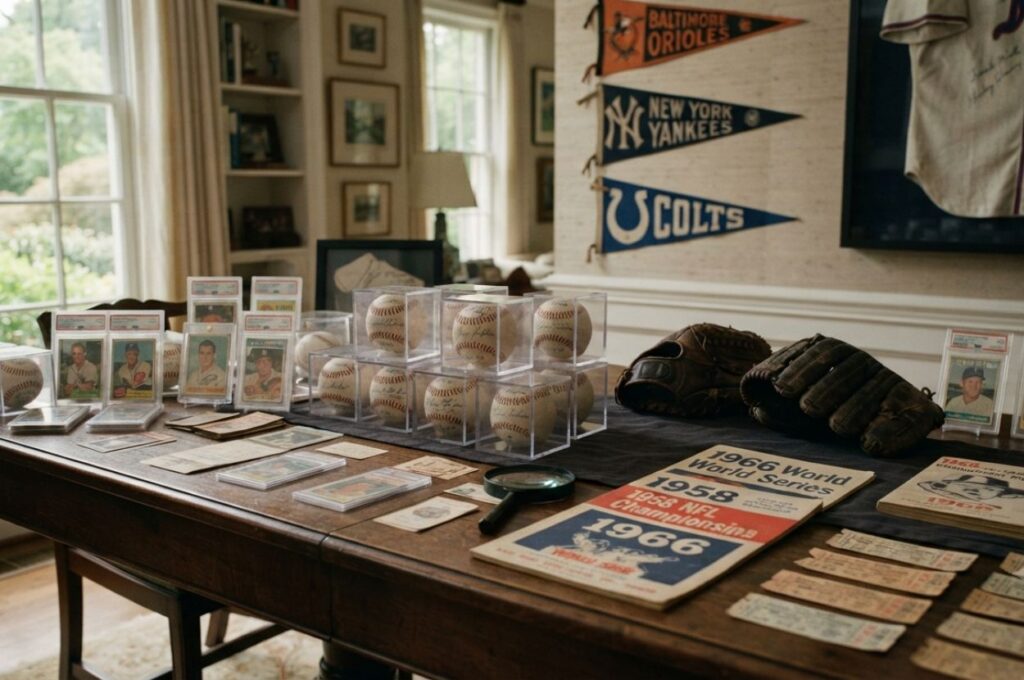
Trading cards
Baseball, football, basketball, hockey, and others, from vintage tobacco-era issues through modern inserts and rookie cards. Unsorted boxes and binders are worth reviewing before anything is separated out, since the cards that matter are rarely the ones that look impressive.
Autographed items
Balls, cards, photographs, jerseys,programs, gloves, and equipment. Signed pieces create a direct link between a collector and a player, which is what drives the market for them and what makes verification essential.
Game-used equipment
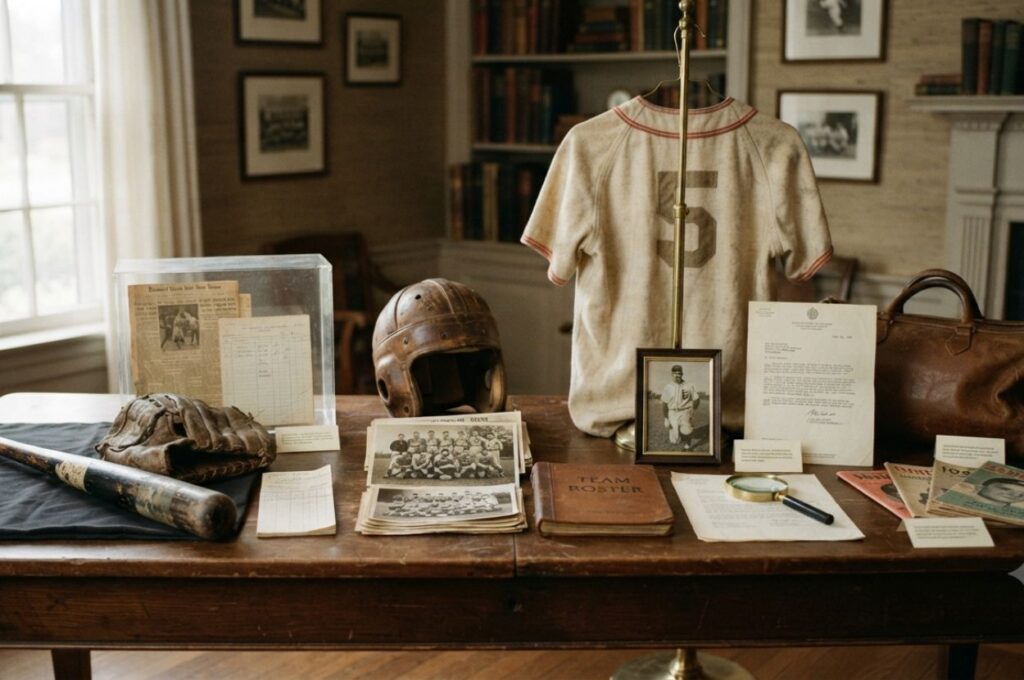
Bats, gloves, jerseys, helmets, and gear with a documented connection to a specific player, game, or season. Documentation is what separates game-used from merely old.
Jerseys and uniforms
Game-worn, team-issued, and authenticated retail pieces occupy three quite different value tiers, and families are often unaware which one they hold.
Vintage and historical pieces
Pennants, programs, ticket stubs, championship memorabilia, and franchise or era-specific items. These preserve a piece of sporting history, and collectors of a particular team or era will pay for items that fill a gap in a collection.
Non-sports collections such as coins, comics, stamps, records, and trading card games including Pokémon are valued on a different basis. For those, see sell collectibles.
What Drives Sports Memorabilia Value
Four factors do most of the work across nearly every category, and understanding them explains why two seemingly identical items can differ in value by an order of magnitude.
Authentication and provenance
For signed and game-used items, authentication does most of the work.
The market treats an unverified autograph as unverified regardless of how genuine it may be, so a piece with strong family history but no paperwork sits in a different tier from one with certification.
Provenance, meaning the documented chain of how an item came to be where it is, supports both authentication and value. Where a family has letters, photographs of the signing, original purchase records, or prior certification, those documents should be kept with the item.
Professional grading
Cards are graded on centering, corners, edges, and surface, and the resulting numeric grade is priced directly by the market. Two copies of the same card in visibly similar condition can carry very different values once graded.
This is why cards are best reviewed before any decision is made about whether grading is worth the cost.
Condition and era
What matters is survival rate rather than age on its own. Cards produced before the 1970s were printed in smaller quantities, handled without protection, and rarely stored well, so surviving examples in strong condition are scarce. Manufacturer, printing errors, and variations within a run all factor in as well.
Player and market demand
Demand tracks the player and the era. Items connected to a player often appreciate following a hall-of-fame induction, a milestone, or a career close, and collector interest in specific eras and franchises moves over time.
Part of the assessment is a view on whether the current market favors selling now or holding.
How Signed and Game-Used Items Are Verified
Signed items are examined against known exemplars of the player’s signature, accounting for how a signature changed across a career.
Where certification already exists, the certifying body matters, because the market does not treat all authenticators as equivalent. Game-used claims are assessed against photographic evidence, team records, manufacturer tagging, and wear patterns consistent with actual use.
Families frequently hold items with a strong family account of origin but no paperwork. That account is worth recording in writing, because a credible, documented history often supports authentication even when a certificate was never issued.

How to Prepare a Sports Collection
- Leave everything as found. Do not clean, polish, or press anything. Surface condition is a graded criterion, and improving the look of an item almost always reduces what it is worth.
- Do not remove cards from holders or slabs. Graded cards lose their grade the moment the case is opened.
- Keep documentation with the item it belongs to. Certificates, receipts, ticket stubs, and photographs are frequently found in a different room from the piece they authenticate.
- Write down the family history. Who obtained the item, when, and under what circumstances. This is often the only provenance that exists.
- Move the collection out of poor storage. Damp basements, unheated attics, and direct sunlight cause the damage that grading penalizes most.
How the Selling Process Works
There is no single correct route, and a large collection is often best split across several.
1. Gather the collection
Bring the collection together in one place and leave it as found. Set aside any documentation you can locate so it can be reviewed alongside the items themselves.
2. Schedule a consultation
A conversation about what the collection contains, how it came to the family, and what the timeline looks like. Photographs are usually enough to start.
3. Assessment and appraisal
Items are reviewed for authentication, condition, and grading potential. Where a formal valuation is needed for probate, division among heirs, or insurance, iStuffSellers can arrange licensed personal property appraisals.
4. Choose the selling route
Individually significant pieces generally do best at auction, where competitive bidding sets the price. Mid-value items often suit consignment, which gives them sustained exposure to the right buyers. Where the collection sits within a full household, an estate sale handles everything together. Large collections are commonly split across more than one route.
5. Sale and settlement
Marketing, buyer outreach, and the transaction are managed on your behalf. A settlement statement is issued when the sale completes, followed by payment.
Working With iStuffSellers
iStuffSellers is a full-service estate liquidation company based in Rockville, Maryland, serving Montgomery County, the greater Washington DC metro area, and surrounding communities in Maryland and Northern Virginia.
We are fully licensed to buy and sell antiques and collectibles and are accredited by the Better Business Bureau.
Because appraisal, sale, and cleanout are handled by the same team, a sports collection does not have to be separated from the rest of the household to be dealt with properly.
Jewelry, furniture, china, electronics, and vehicles are assessed in the same pass, so a family settling an estate works with one point of contact rather than coordinating several vendors.
Areas We Serve
including Bethesda, Chevy Chase, Potomac, North Potomac, Kensington, Gaithersburg, Germantown, Silver Spring, and Wheaton, along with Washington DC and Northern Virginia. For full coverage, see our service area.
Frequently Asked Questions
How are sports cards and memorabilia authenticated and valued?
Sports items are valued on authentication and provenance, professional grading, condition, and demand for the player or era. Autographed and game-used pieces generally need documentation to reach their full value, which is part of what the review process establishes.
What sports memorabilia tends to be worth the most?
Not every piece carries significant value. The items that typically do are authenticated game-used equipment, high-grade vintage cards from before the 1970s, rookie cards of players who went on to notable careers, and documented autographs of significant figures.
Condition and documentation matter more than the item type on its own.
Do I need to have my cards graded before selling?
Not always. Grading adds cost and time, and it only makes financial sense when the expected grade justifies it. That determination is made during the assessment, which is why cards are best reviewed before any grading submission.
Schedule Collectibles Consignment in Rockville, MD
Whether a sports collection was assembled deliberately or inherited without explanation, the useful first step is the same. Find out what is actually there before deciding anything, at no cost and with no obligation attached.
Schedule a free consultation with iStuffSellers, or call 301-401-6688.
Stop searching for “estate sale services near me,” and contact iStuffSellers online today